@westerosorg asked: Shift in cover art for SF/F, from more illustrative towards more abstract/graphic, seems more pronounced in UK than US. Why?
Thanks for your question @westerosorg! I can’t really speak for the US or even the UK market as a whole, but I’ll try to give some insight into cover design from the Voyager/HarperCollins art department team perspective.
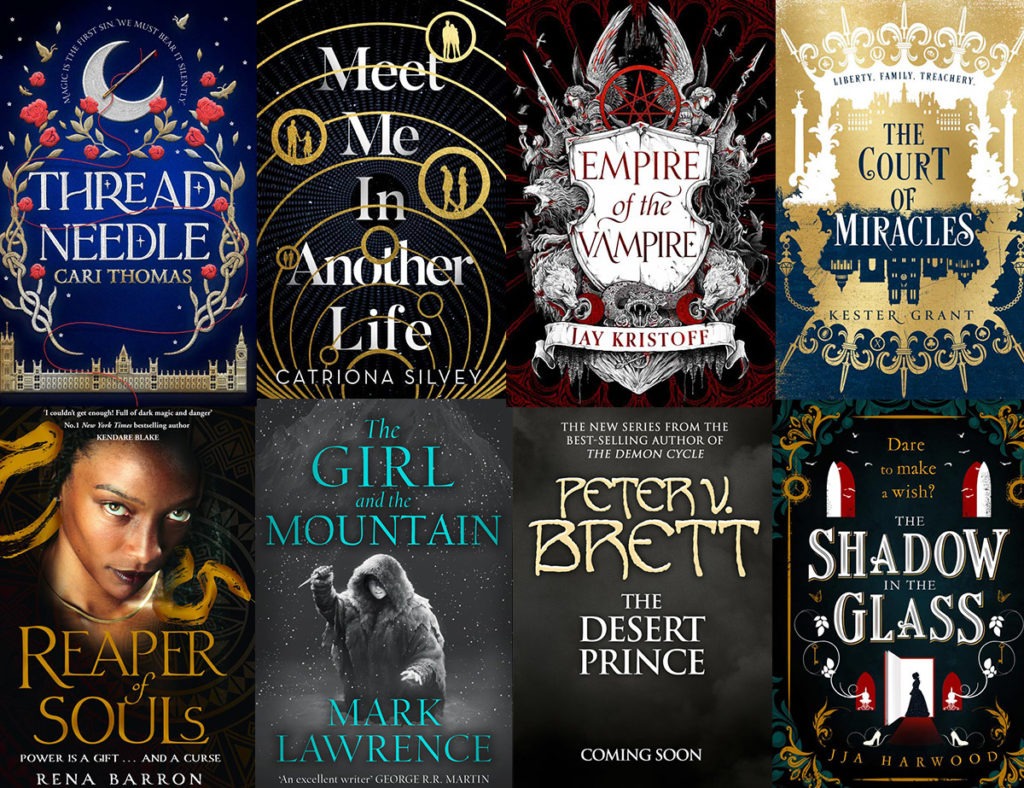
The great thing about the fantasy genre is that the fantasy market is actually very evenly spread across genders and age groups. The challenge is then that our book covers have to work for an extremely varied audience. We also have to be extra careful not to alienate any potential readers as external market research has shown us that sometimes more traditional-looking, illustrative fantasy covers are off-putting for newcomers to the genre. There’s a whole website dedicated to ridiculous fantasy covers — and while hopefully we are doing better nowadays there is still a negative perception towards fantasy books (‘trashy’, ‘weird’, ‘dated’ come to mind) that we have to push back against. Basically, more graphic, elegant covers are hopefully appealling to our extremely loyal genre fanbase as well as to new readers who perhaps wouldn’t expect to enjoy a ‘fantasy’ novel — and changing the perception of the genre as a whole.
A recent trend in cover art is the use of an iconic image or symbol to tie a series or an author’s backlist together to create a coherent ‘brand’. One of the most challenging aspects of fantasy publishing is developing a clear ‘series style’ (and later, an author style once an author has been established). It is also important to make it as easy as possible for readers to find and identify books in a series without too much hassle.
An obvious example is our Feist backlist:
But the relationship between sci-fi/fantasy cover art and illustrators is and will always be important. Even with our focus on more ‘graphic/iconic’ covers, we still try and cultivate relationships with artists like Jackie Morris – who did our Robin Hobb covers and is also updating the Megan Lindholm backlist for May 2011.
It’s also fair to say that the trend might be going too much over to the other side and we might be seeing a return to more illustrative covers in the future. We know that The Desert Spear cover is very popular in-house and is even up for an in-house design award…
This also seems like the perfect time to mention the Stephen Hunt cover redesign. There will be a follow-up post on this as well, as I attempt to pick the brain of our brilliant designer as to his thoughts on the new look for Stephen Hunt’s rollicking steampunky adventures. As you can see, it’s very different.
Do you prefer fantasy covers of old? Are there any covers in particular you love or hate? Would love to hear thoughts here in the comments and @_thevoyager_.
Tags: covers, Peter V. Brett, Raymond E. Feist, Robin Hobb, Stephen Hunt


What I don’t like is when you change covers mid-series! I have Stephen Hunt’s steampunk books looking wonderful on my shelf and then you go and change things before the series ends. I like my series books to have consistency on the shelf, but now you’ve gone and pretty much ruined that. I dislike mid-series cover changes so much, that I’m actually considering not buying the rest of the books. If they don’t match, I don’t want them on my shelf. If I feel like reading them I’ll just borrow them from the library instead. And the new Stephen Hunt covers? They look cheap in comparison to the wonderful line-drawn elegance of the early series covers.
I think in the market I prefer Voyager’s covers on the whole; I like the subtlety and I agree that you can pick out an authors books quite quickly. However – I *loved* the John Howe covers for Hobbs’ novels and actively sought out those editions of the Liveship trilogy so I personally am sad about a shift away from traditional illustrations. If the picture is done right then it can make a huge difference – look at the cover for the US edition of Brandon Sanderson’s new novel “Way of Kings” (I know, not one of yours) it is stunning. Sadly one does tend to judge a book by its cover.
I love the cohesiveness of Voyager’s series- such as Robin Hobb but I also really love the bold illustrative ‘old’ style covers. Saying that, I just love science fiction and fantasy and when I’m reading one, I want people to know that’s what I’m reading. I think I identify the genre with a type of cover now but because I love the genre I dont see the covers as ‘trashy’, more unique
I’m also big on having neat looking bookshelves. Series should look like they belong together!
This is somewhat blowing my own trumpet, but I think the cover of a book really does matter. For my alternative history, Beneath Gray Skies, I chose a fairly pedestrian image of a slightly chopped Hindenburg over a Confederate flag (the Stars and Bars) against a background of clouds. I changed this when I changed the edition to a slightly different version of the Confederate flag, which was made much more transparent and much less “in your face” than the original. People definitely seemed more taken with this. For the hardback edition, I went to town – I combined a number of different symbols, and the general impression seems to have been good (you can find the different covers on Amazon, etc.).
I’ve been told that my thriller, At the Sharpe End could sell 30% of its copies on its cover. Again, you can see this on Amazon. Since the two books have nothing in common, I saw no point in any commonality in the covers.
As AShR says, the new Hunt covers are cheap, generic and ugly. It is particularly galling since the old ones are so nice. If I was Stephen Hunt I would be crying.
And yes, swapping style mid-series is immensely irritating.
I have to agree a bit on changing the cover design part way through a series. This has been an issue with George R.R. Martin’s books which have gone through two versions in the U.K. I believe, and three versions in the U.S. (although they have at least re-released editions with the new design, something I know Voyager is not capable of doing).
I do like strong graphical or minimalist designs, but some of the ones put out there just seem very bland to me, personally. For example, Robin Hobb’s _The Inheritance_ is not a favorite of mine — two cats staring at each other says nothing to me, as a potential reader. It can be seen here: http://drawingalineintime.blogspot.com/2010/08/inheritance-by-robin-hobb.html
Perhaps it references one of the stories in the anthology? I don’t know that I, as a reader, would be pulled over to this cover if I saw it (well, I would be, buot solely for the author’s name). And for someone who does not know Hobb, who does not know her work, this doesn’t say “fantasy” or anything at all. When you have an artist like Jackie Morris to hand, why … cats? Yes, she does beautiful animal paintings, but cats are just … cats. Why not something that speaks of the Six Duchies setting? Dragons or sea serpents, or liveships. It would still be beautiful, but it seems to me it’d be more striking,
I do like the rest of the design, as far as font choices, the background, and so on. But I question the use of seemingly-random, uncommunicative imagery in the foreground.
AShR & Martin> Cover design really divides opinion, and it happens as much in-house as it does in the outside world. Stephen’s older covers were beautiful, but the cover redesign has a lot to do with helping him and his writing reach a broader audience and growing him as an author. The launch of the newest standalone title, Jack Cloudie, is the best place to do that. It’s also a brilliant book so hopefully you won’t be dissuaded from reading on!
Sean> That Sanderson cover is stunning!
Elio> it’s a shame you don’t like The Inheritance cover! It really is stunning in real life and Jackie’s drawings are superb. I think it’s a ‘see-it-in-person’ kind of cover, as there are many layers of meaning… the cats of course tie in with a few stories in the book but they are also a reference to the ‘two authors’ writing in the collection, and the back cover (with Megan Lindholm’s name instead of Robin Hobb) hopefully makes the two cats make more sense.
On the topic of the Stephen Hunt covers, I rather dislike _Jack Cloudie_. _Secrets of the Fire Sea_ (illustrated) is appealing, but looking at the line drawings, I think I rather adore those (and now, suddenly, I’m thinking I shall have to order the first novel.) I have to agree that perhaps in this particular case, going from a strong graphic design to illustrated feels like a misstep. But I’m sure the marketing and art departments know what’s best…
[...] This post was mentioned on Twitter by HarperVoyager, HarperVoyager and thePlenty.net, Sharon Ring. Sharon Ring said: RT @_TheVoyager_: Great discussion happening on the Voyager blog… SF/F covers and redesigns, what are your thoughts? http://bit.ly/aQ0thx [...]
[...] Judging a book by its cover… on the Voyager blog.Voyager explains why they favor a graphic icon for their cover designs, saying “market research has shown us that sometimes more traditional-looking, illustrative fantasy covers are off-putting for newcomers to the genre.” I’ll agree that most of those old 1980s-90s fantasy covers are pretty awful. However, I’d say the problem is more with the illustration style and the accompanying type treatment. I like the cover illustration approach seen on the more recent books by US publishers Orbit and Tor. [...]
Wii Wii…
[...]Judging a book by its cover… | Voyager Books[...]…